

In conversation with Science for Pre-schoolers
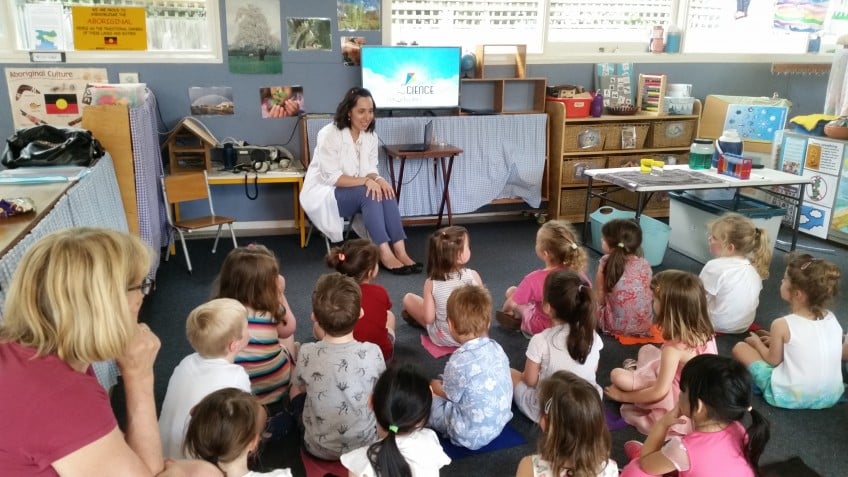
This spring, our resident host for Playdate at the Library is Science for Pre-schoolers. We chatted with co-founder Joelle about her tips for at-home learning, and fostering creativity and curiosity in children.
Hi Joelle! Firstly, do you have any advice for parents trying to keep pre-schoolers entertained and stimulated at home?
As a mother of five, I think it’s important to realise we don’t need to ‘keep kids entertained’. They have a natural curiosity about the world around them, so simply provide them with the opportunity to develop life skills that naturally occur in the home such as cooking, cleaning, exercising etc.
The point is to include your child in everyday activities. For example, if you’re cooking, get them involved and talk about all the different things going on in the process. Why do we need to cook, what can they observe, what do they think will happen, what does happen in the end etc.
This can be applied to so many daily things such as gardening, doing the laundry, vacuuming, tidying up, going out for a walk to exercise, making the bed etc. Often as parents we want to do these things ourselves because it's faster/easier/less of a mess, but involving your children is really setting them up for life by teaching them the life skills they will need well into adulthood, and of course it gives them something to do thus keeping them entertained.
With many parents working from home at the moment it can also be useful to set up some activities for your children. Simply placing out some different activities everyday while you are working can be helpful. Some useful and easy to do activities include puzzles, drawing/colouring, water play, playdough, tap tap set, building blocks, Lego, magnetic blocks, books.
How do you find is best to encourage curiosity and discovery in kids?
Using the scientific method helps stimulate that curiosity in them. Some helpful questions are:
- what can you see/feel/hear? (observe)
- what do you think is happening/going to happen? (hypothesis)
- what do we need to do this? (materials)
- how can we do this? (method)
- what happened in the end? Why? (result/conclusions)
Asking these questions with reference to everyday activities is the simplest way to incorporate this. By doing this we are also encouraging our children to be independent thinkers.
Do you have a favourite activity which would be easy for parents to recreate?
That would be anything involving water play, placing a variety of different containers with water coloured with food dye in a tray to contain mess.
There’s so much science to be learnt in this - measurement/volume, flow and motion, cohesion and adhesion, buoyancy, density, displacement, porosity, colour spectrum, surface tension, mixture, liquids and the list goes on.
You could add some objects, some that float and others that sink or dishwashing liquid to create some bubbles.
What tips would you give to parents wanting to introduce their little ones to a new topic, like science?
Don’t be afraid to let your child explore and be ok with mess, it’s this hands-on fun that they can both experience and learn from.
Hopefully, after joining our program at the Library we will provide them with the inspiration to continue the fun of science at home. They can also reach out to us or their child's educators if they want specific ideas.
We are all here to support each other in being superhero scientists!
Join Science for Pre-schoolers for Playdate at the Library every Wednesday at 10.30am. Book now!