
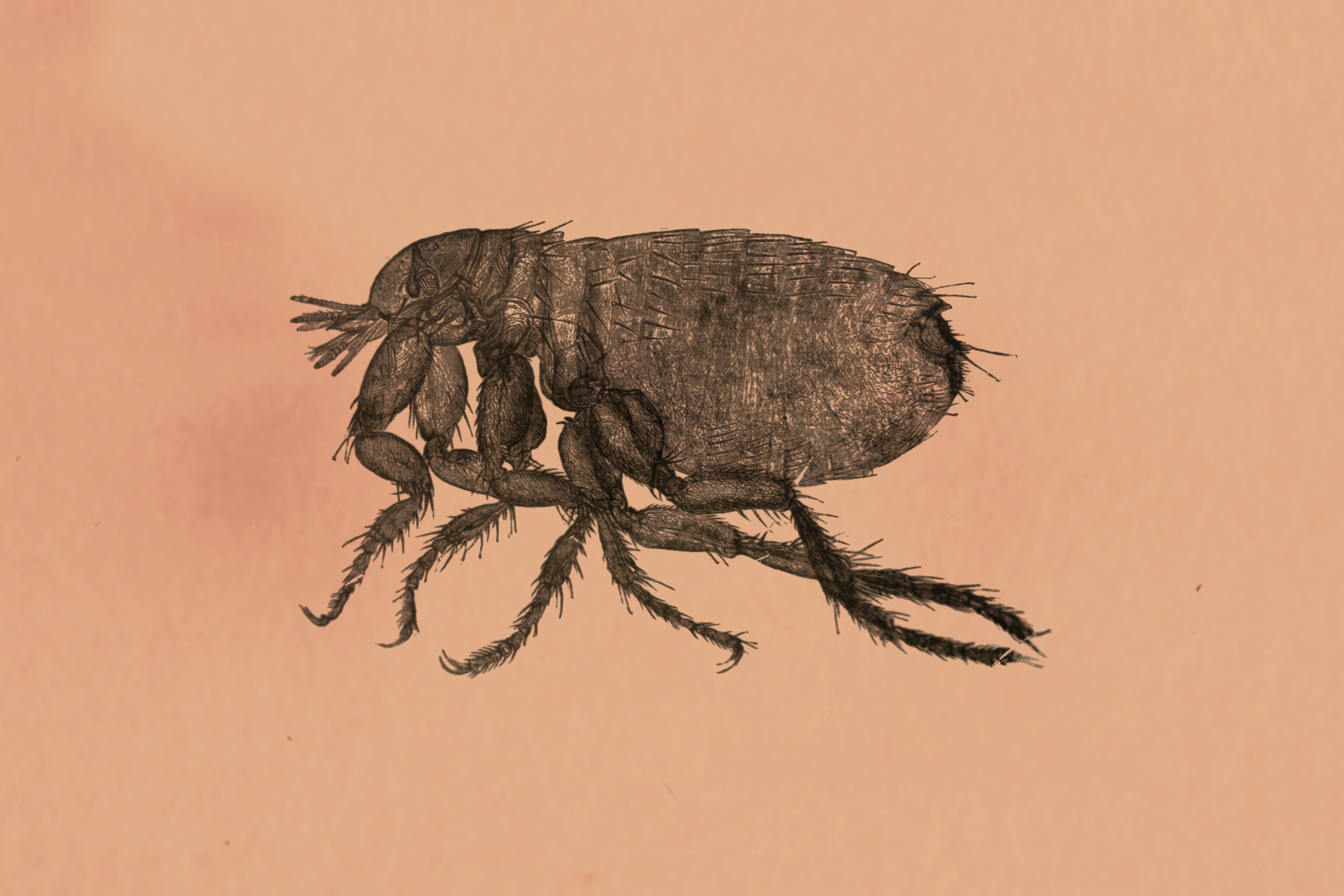
How a medieval plague flea made its way into our collection
State Library Victoria holds a collection with over 4.5 million objects, some significantly more unusual than you might expect. We have puppets adorned with human hair, biscuits from WWI soldier rations, 70 years’ worth of Redhead matchboxes and much more. But one of the most interesting items we carry is a medieval flea that was likely around while the bubonic plague tore through Europe.
The flea was discovered back in 2008 when the Conservation team was rebinding Codex Sancti Paschalis, a 13th-century Italian missal (a book that priests use to say mass). Senior Conservator Katrina Ben cleared out all kinds of material within the book, including dust, glass, a daddy-long-legs spider and a silverfish. There was also a tiny flea, which Katrina and her team sent to Museums Victoria for analysis.
Museums Victoria identified that this was an Oriental rat flea (Xenopsylla cheopis), the same type of flea that carried the plague bacteria (Yersinia pestis) which killed around one-third of Europe's population in the 14th century and precipitated enormous social change. We can't be sure whether this flea was infected with the plague, but it certainly is a possibility.
We do know this book was in Italy when the plague was ripping through the continent. And that this species of rat flea was responsible for its spread.
'The flea is part of a whole cast of characters that were found inside the manuscript – and all of them have more to tell us about where it's been.'
But how did this book make its way from Perugia, Italy (around the year 1290) to State Library Victoria today? What Principal Collection Curator Anna Welch uncovered, when it comes to this book’s marvelous history, is that it would have fallen out of use after the Council of Trent (1545-1563) because the liturgy was updated at this time. It was later owned by the Benedictine monastery in Nonantola in Modena, and then the Cistercian abbey in Fossanova, south of Rome.
Anna learned that it was eventually purchased by the eccentric English collector of manuscripts Sir Thomas Phillipps from the booksellers Payne & Foss in 1848. In the 1940s, around 70 years after Sir Thomas’s passing, the London bookseller WH Robinson sent batches of manuscripts (including this book) to State Library Victoria to be exhibited and hopefully purchased.

Codex Sancti Paschalis, Crucifixion miniature, folio 181v-182r.
The Library did acquire several of these manuscripts, however, this religious book was highly desired by the Australian Franciscan Friars. The Library stepped back so the friars could purchase the book in 1949, and it stayed at their friary St Paschal's in Box Hill until the 1990s. This is when State Library Victoria received the book on a long-term loan to ensure it was conserved and safely stored. It is cared for at the Library but remains owned by the friars.
Ultimately, we're not sure when this book picked up the flea, but its journey to Australia is clearly a long and winding one.
For more information about this book’s origins and significance, you can watch a talk between Principal Collection Curator Dr Anna Welch and Senior Conservator Katrina Ben.
Top image: an edited version of Fig. 48 Fac-simile[i.e. facsimile] of a flea, obtained by the photomicrographic apparattus, John Henry Harvey, circa 1855-1938.