
National Family History Month

About National Family History Month
August is National Family History Month and there’s no better time to delve into researching your family history.
Whether you’re a beginner or an experienced researcher, State Library Victoria has a wealth of workshops and resources to help you on your research journey.
We'll be sharing new family history blogs throughout August to celebrate Family History Month, drawing on our expert librarians' wealth on knowledge on the topic.
Happy researching!
Family history tools and resources
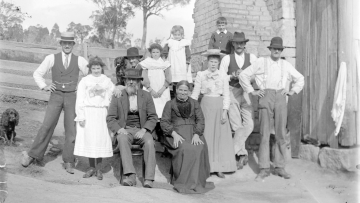
Country family with city man, c.1900, James Fox Barnard, 1874–1945; H2002.125/26
The Library is the perfect place to explore your family history. From research guides to online resources and talks, find all the inspiration and tools you need to research your family’s past.
Browse our family history tools and resources.
Ask a Librarian
Do you have a family history research query? Need help finding information?
Our expert staff can help answer your questions and offer research guidance.
Ask a Librarian online, in person or via phone today.
Researching Your Home

Three children standing on veranda of single storey weatherboard house with established garden. H2009.60/11
Oh what stories houses would tell, if only they could talk!
This webinar will help to answer the questions and curiosities you may have about your family home, whether it’s the house you’re living in now or the scene of your childhood memories.
Date: 2-3pm Thursday 13 August 2026
Book tickets to Researching Your Home.
Introduction to Newspapers and Family History Reading Room

Eugene Hyland
Discover how the Library’s rich collection can help piece together your family tree to uncover hidden secrets and fascinating details about your ancestors’ lives. Learn the skills you need to master the Library’s databases and efficiently use the research equipment.
Dates: 2–3pm on 19 and 25 August 2026
Book tickets to Introduction to Newspapers and Family History Reading Room.
Newspapers for Family History

Learn how to navigate the Library’s extensive newspaper collection to research your family history in this live and interactive online session.
Our collection includes over 4000 different local and international papers, dating back to the 18th century. You'll dive into the millions of words printed on both current and historical articles in our online databases, and discover how to find specific newspapers in hard copy, online and on microfilm.
Date: 2-3pm Tuesday 4 August 2026
Book tickets to Newspapers for Family History.
Want more family history content?

Weatherboard house – Torquay cottage, c.1890–1900; H2005.34/57
Sign up to our newsletters and be the first to receive all family history-related content. From workshops to research guides and blog posts, there are a lot of ways we can help solve your family mystery.
Collection of wills from Cohen, Kirby & Co. Solicitors, Bendigo

‘Presumed dead’. Excerpt from the Will of Bridget Hynes of Leongatha, widow, 1903 September 17. MS 17028 BOX 4/3
A recent donation to the Library gives us insight into the last wills and testaments of Victorians of the 19th and 20th Century, from what they were bequeathing to who they held dear.
Read our blog to discover the stories, relationships and legacies hidden within this unique collection of Victorian wills.
Online Collection Spotlight: Migration to New Worlds

Settling In: A Guide for your Early Days in Australia, Victoria edition, leaflet, Marlborough, Wiltshire: Adam Matthew Digital 2017.
Learn more about Migration to New Worlds, a multi-archive database of sources relating to migration from Great Britain, Ireland, mainland Europe, and Asia to Australasia and North America.
The database consists of diaries, correspondence, photographs, maps, oral histories and other primary documents, which have been selected from more than 25 archives, libraries and museums, including the British Library, National Archives (UK), University of Melbourne Archives, Maritime Museum of Tasmania, Museums Victoria, National Archives of Australia and the National Library of Ireland.
Listening to the enemy: Melbourne’s radio listening post in World War II

In the officer's mess, Aust, c.1942, Argus Newspaper Collection of Photographs, State Library Victoria, H2000.200/1206
During World War II, radio broadcasts were used to convey military news and to boost morale. Radio was also the perfect medium to spread propaganda to the enemy, with the aim of belittling or demoralising enemy forces and civilian populations.
Read the intriguing story of how a Melbourne short wave station recorded Japanese propaganda messages to help the allied war effort on our blog.
Courting in the colony: finding a partner in 19th-century Australia

Digger's wedding in Melbourne, S. T. Gill, 1869; H86.7/38
The course of true love never did run smooth, but what was it like finding love in early colonial Australia?
Read our blog to learn more about securing a match in the 1800s.
Online Collection Spotlight: Life at sea
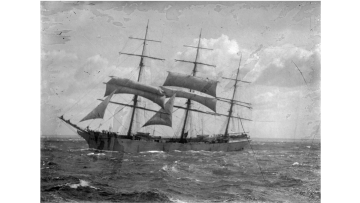
(Ship), Allan C. Green, 1878-1954, [ca. 1900-ca. 1954]; H91.325/2495
Read our blog about the Life at Sea database, which brings together material from maritime archives and heritage collections in England and the United States.
Voyage through the 17th and 18th centuries and discover what life was like during the Golden Age of Sail with a fascinating collection of artefacts, diaries, memoirs and artwork from those who experienced the open waters first hand.
‘Doing the Block’: promenade on Collins Street

Doing the Block. Gt. Collins St., S. T. Gill, 1880; H332
‘The Block’ was a section of Collins Street bounded by Elizabeth and Swanston Streets. It was considered one of the primary places to see and be seen in the Melbourne CBD as early as the 1860s, but it reached its zenith during the economic boom years in the 1880s and 1890s.
Read our blog about ‘Doing the Block’ and those who did it – the Melbournians dressed in their finest as they frequented the fashionable cafes, tea houses and shops along Collins Street.
Interested in the history of your home?
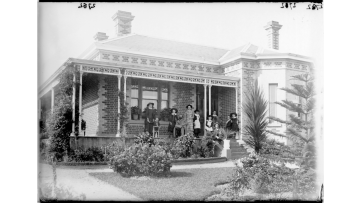
[Family posed on verandah of house, probably in Melbourne];John Henry Harvey, [ca. 1890-ca. 1910]; H86.76/36
Would you like to learn more about the history of your home or the home your ancestor lived in?
Unless it’s a well-known property, it’s unlikely you will find a detailed published history but there are ways to find information about your house and the occupants who lived in it.
Take a look at what resources can be used to research the history of a property in a blog written by librarian Carmen Quick.
Researching births, deaths and marriages in Victoria

Wedding ceremony and guests, [197-?]. Photo by Maggie Diaz. This work is in copyright. H2013.261/547
Major life events such as births, deaths and marriages are some of the key milestones in a person’s life, and are a great place to start when researching an ancestor.
Read our blog to find out where these certificates are, how to you search for them, and what they might contain.