
Access and inclusion
The Library is committed to improving access and inclusion for the one in five Australians – and more than one million Victorians – with a disability.
Patrons are welcome to provide feedback on accessibility by speaking with a staff member or filling out our online feedback form.
Getting around the Library
Wheelchair, lift and stair access
- Most Library spaces are accessible by wheelchair.
- Lifts provide access to the Gateway Zone and Cowen Gallery, The Ian Potter Queen's Hall, Dome Galleries, Redmond Barry Reading Room (except the mezzanine/Level 3), La Trobe Reading Room and the Heritage Collections Reading Room.
- The mezzanine/Level 3 of the Redmond Barry Reading Room is not available by public lift. If you have trouble using stairs, please let our friendly library staff know who can assist you to use the staff lift, or they can retrieve materials for you.
- Level 4 of the Dome is only available via lift (no stair access).
Booking a free wheelchair
- A manual wheelchair is available for visitors to move around the Library, or attend Library events and exhibitions. We are unable to provide staff to push wheelchairs.
- Book a wheelchair ahead of time by using the online booking form. Alternatively, call 03 8664 7000, between 10am–5.45pm daily.
Getting here
For information on getting to State Library Victoria – including where to find wheelchair ramps, low-floor trams and parking for disability permit holders – visit our getting here page.

Accessible toilets
There are separate male and female accessible toilets in these spaces:
- Hansen Hall, in the Swanston Street Welcome Zone on Level 2 (ground floor).
- Gateway, Level 2 (ground floor), next to the lifts.
- Russell Street Welcome Zone, via La Trobe Street Entry 5.
- Ian Potter Queen's Hall.
- The Children's Quarter, Level 2 (ground floor) has joint facilities for carers and children.
Maps
- Download a Library map here.
- This map is also available in Chinese and Japanese.
Assistance dogs
Registered and identifiable assistance dogs are welcome when with their handler.
Quiet spaces
The Arts Reading Room is a designated silent room. Other quiet and low sensory spaces can vary by the time of day. Recommendations for other quiet and low sensory spaces include:
- Ian Potter Queens Hall, open 10am-4pm daily.
- Study Space, located above the Create Quarter. This room has a variety of seating options. There is some echo, depending on noise levels from the Create Quarter below.
Accessing Library resources and services
Assistive Technology
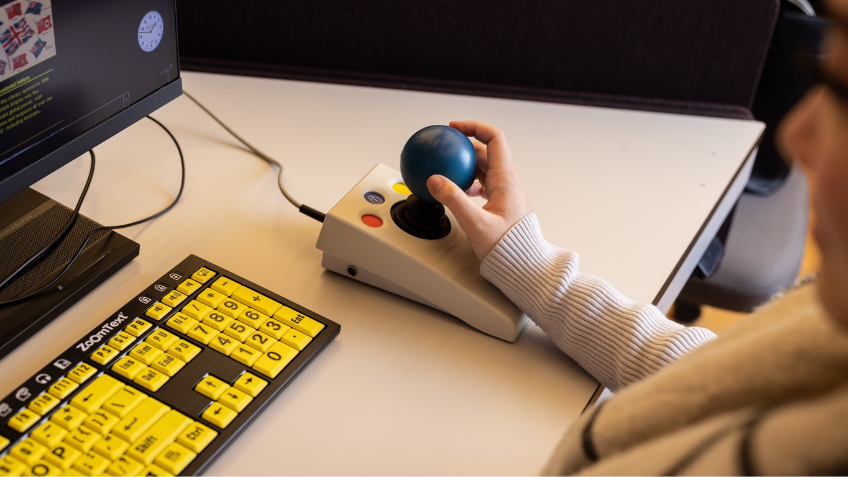
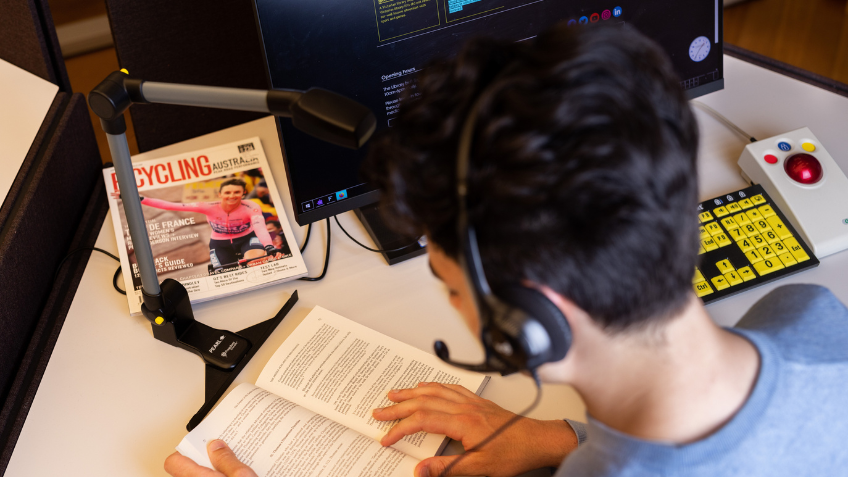
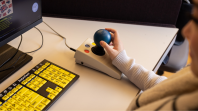
- There are 3 assistive technology computers available. These are reserved for visitors with accessibility requirements, such as vision, mobility or learning disabilities.
- Learn more about the Library’s assistive technology here: Assistive technology at State Library Victoria.
- Assistive technology is located in the Information Centre on Level 2 (ground floor), and the Redmond Barry Reading Room, Level 2A.
- There are 25 general access PCs in the Information Centre.
Reading assistance tools
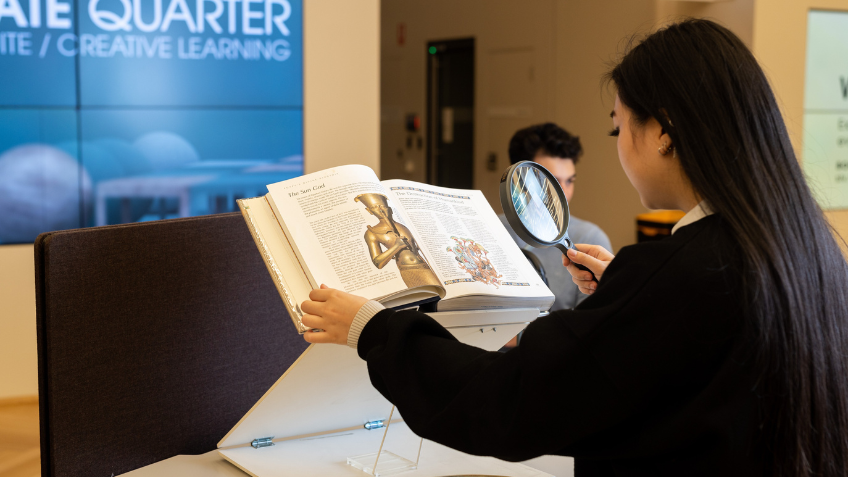
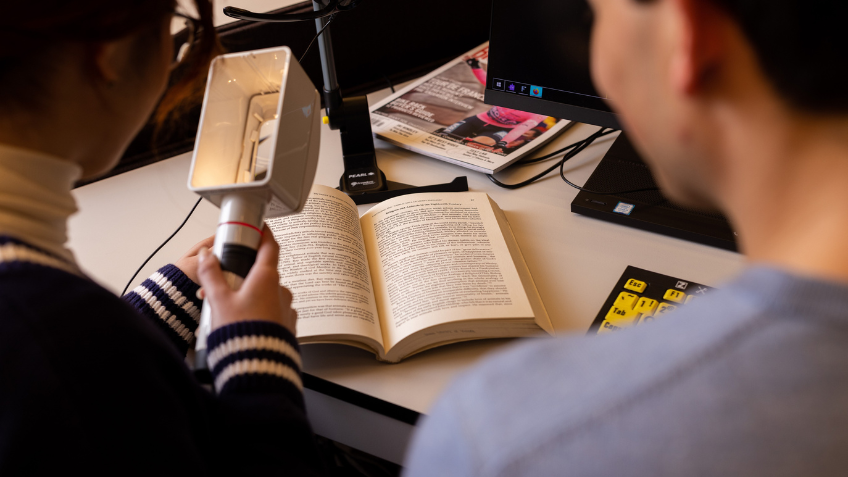
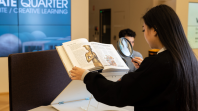
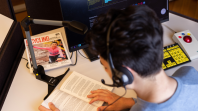
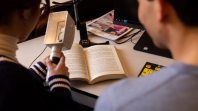
- Book rests, magnifying sheets, illuminated magnifiers and video magnifiers are available.
- Please ask our friendly staff for assistance or see the magnifiers section in the Assistive technology guide for more information.
Access and Inclusion Librarian
- The Access and Inclusion Librarian is available to assist visitors with disability and their carers to access the collection and Library services.
- The Access and Inclusion Librarian can also provide information about other organisations that may be of assistance.
- The Access and Inclusion Librarian can be contacted at accessinclusion@slv.vic.gov.au or on 03 8664 7005.
Online resources
State Library Victoria has over 600,000 digitised collection items, access to 1 million ebooks, and 1 billion online articles. You will need your membership details to access many of the Library’s electronic resources.
For more information, please see:
- Accessing eresources from home
- Help using our catalogue
- Collection discovery (to browse digitised items)
- Ebooks: using our ebook collection
Web accessibility
State Library Victoria is committed to making its website accessible. We are working to improve web accessibility and compliance. If you experience problems accessing our website, please let us know through our online feedback form.
We will try our best to resolve the problem or provide what you need in an alternative format.
National relay service
- Contact us through the National Relay Service, asking for 8664 7002.
- For more information, visit the National Relay Service website.
Events and tours
- The Library offers free guided tours of permanent and temporary exhibitions, paid tours, and free library services orientation tours. All are available with accessible routes.
- The Library is committed to further exploring and implementing improved access for community events, such as providing AUSLAN interpretation and programming autism-friendly sessions for young learners and families.
- The Library worked with Arts Access to provide disability awareness training for staff, and to assess the quality of our services – particularly in our galleries and gallery tours – from the perspective of people with lived experience of disability. This assessment will form the basis of improvements to accessibility in our exhibitions spaces.
Companion card
- If you require support from a companion, and qualify for a Companion card, that person will receive free entry to any paid Library events on presentation of that card.
- If you book a ticket over the phone, please let us know that you require a Companion ticket.
Audio hearing loops
Permanent hearing loops are in:
- State Library Victoria Theatrette
- Ian Potter Queen’s Hall
- Hansen Hall
- Digital lab and Study room – both in Create Quarter
- Pauline Gandel Children’s Quarter
- Ideas Quarter mezzanine
- Create Quarter
Portable hearing loops are also available for our other event spaces and for visitors attending tours. To borrow a unit, please enquire in the Welcome Zone, or at the tour meeting point.
An accessible workplace
State Library Victoria provides a workplace that actively welcomes and values the unique contributions of all people. The Library is an equal opportunity employer and acts in accordance with our obligations under the Victorian Equal Opportunity Act 2010 and the Victorian Charter of Human Rights and Responsibilities. Disability awareness training for staff and volunteers is an ongoing priority.


